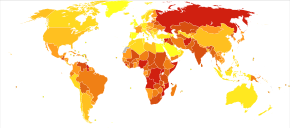
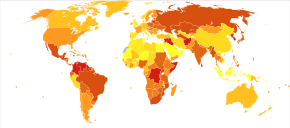
Injury, also known as physical trauma, is damage to the body caused by an external force.[1] This may be caused by accidents, falls, hits, weapons, and other causes.[1] Major trauma is injury that has the potential to cause prolonged disability or death. In 2013, 4.8 million people world-wide died from injuries, up from 4.3 million in 1990.[2] More than 30% of these deaths were transport-related injuries.[2] In 2013, 367,000 children under the age of five died from injuries, down from 766,000 in 1990.[2] Injuries are the cause of 9% of all deaths, and are the sixth-leading cause of death in the world.[3][4]


Classification
The World Health Organization (WHO) developed the International Classification of External Causes of Injury (ICECI). Under this system, injuries are classified by:
- mechanism of injury;
- objects/substances producing injury;
- place of occurrence;
- activity when injured;
- the role of human intent;
and additional modules. These codes allow the identification of distributions of injuries in specific populations and case identification for more detailed research on causes and preventive efforts.[5]
The United States Bureau of Labor Statistics developed the Occupational Injury and Illness Classification System (OIICS). Under this system injuries are classified by
- nature,
- part of body affected,
- source and secondary source, and
- event or exposure.
The OIICS was first published in 1992 and has been updated several times since.[6]
The Orchard Sports Injury and Illness Classification System (OSIICS), previously OSICS, is used to classify injuries to enable research into specific sports injuries.[7][8]
By cause
- Causes for injuries fall under two categories: intentional and accidental. Intentional injuries include acts of violence and war, or be can self-imposed like suicide or self-harm. Accidental injuries can come from falling or motor vehicle accidents.[9] Some cases of accidental injuries are injury by stingray or lightning injuries.
By modality
- Trauma
- Traumatic injuries are a body wound or shock produced by sudden physical collision or movement. Injuries associated with trauma are avulsion, bone fracture, injury by blast, internal bleeding and catastrophic injuries.
- Strain, repetitive strain, or sprain
- Strain and repetitive strain are injuries to muscles or tendons. Sprain is an injury to a ligament or ligaments.[10]
- Toxins
- Injury from toxin or as adverse effect of a pharmaceutical drug.
- Other external or internal injuries
- Other injuries can be from external causes, such as radiation, burn or frostbite. These injuries can include radiation-induced lung injury and microwave burn. Injuries from internal causes include reperfusion injury.
By location
Skin:
- Wound, an injury in which skin is torn, cut or punctured (an open wound), or where blunt force trauma causes a contusion (a closed wound). In pathology, it specifically refers to a sharp injury which damages the dermis of the skin.
Head:
- Head injury
- Penetrating head injury
- Closed head injury
Eyes:
- Eye injury
- Chemical eye injury
- Eye injuries during general anaesthesia
Brain:
- Brain injury
- Acquired brain injury
- Coup contrecoup injury
- Diffuse axonal injury
- Frontal lobe injury
Nerves:
- Nerve injury
- Spinal cord injury
- Brachial plexus injury
- Sciatic nerve injury
- Injury of axillary nerve
Soft tissue, musculoskeletal and organs:
- Soft tissue injury
- Tracheobronchial injury
- Acute kidney injury
- Anterior cruciate ligament injury
- Musculoskeletal injury
- Articular cartilage injuries
- Acute lung injury
- Pancreatic injury
- Thoracic aorta injury
- Biliary injury
Body:
- Lisfranc injury
- Knee injury
- Medial knee injuries
- Back injury
- Hand injury
- Chest injury
By activity
- sports[11]
- concussion
- strain
- shoulder injury
- pulled muscle
- rock climbing[12]
- finger injury
- knuckle injury
- Lead climbing injuries
- Reverse bite injury
- Occupational injury
- Ventilator-associated lung injury
- Sea urchin injury
- Illness and injuries during spaceflight
Injury severity score
The injury severity score (ISS) is a medical score to assess trauma severity.[13][14] It correlates with mortality, morbidity, and hospitalization time after trauma. It is used to define the term major trauma (polytrauma), recognized when the ISS is greater than 15.[14] The AIS Committee of the Association for the Advancement of Automotive Medicine designed and updates the scale.
| This article uses material from the Wikipedia article Metasyntactic variable, which is released under the Creative Commons Attribution-ShareAlike 3.0 Unported License. |